

Hi, I’m Dr Dani.
These are my thoughts from articles and posts I’ve written in the past.
Follow to see what’s new.
Why I respect hormone pellets but will never prescribe them.
Can I only see you online?
Hormone pellets, those little beads that a provider will place under the skin of your butt after cutting a small hole, every three months, infused with estrogens or testosterone or both, to make you feel like a champ, are not my favorite. Pellets work for some. Those who love them, think they are the best thing since sliced bread. I, on the other hand, take a more tempered approach.
Pellets have their place. At the turn of the 21st century, when the confusing results of the Women’s Health Initiative (WHI) sent many providers running away from hormones, pellets were an option for women to treat their perimenopausal symptoms. They were expensive. At times, they were the only option. Pellets were the counterculture solution when mainstream medicine was inadequately addressing women’s mid-life health. Pellets found alternative formulations and delivery methods that mainstream pharmaceutical companies weren’t providing.
So what’s my objection? After 25 years, pellets are still expensive. They tend to be cash only, uncovered by insurance. Pellets are still injected every three months. I have yet to see a protocol for what to do with old pellets and scarring. Pellets are still understudied compared to current hormonal treatment alternatives. They are still not FDA approved.
Now, evidence based medicine and mainstream pharmaceuticals have had a quarter century to catch up. While studies on women’s health are still far behind where we would all like it to be, the amount of research in perimenopausal medicine that continues to be published is enough that I became a specialist just to stay on top of it all! We now know that estradiol behaves very differently in the body than ethinyl estradiol. We know that synthetic progestogens affect certain tissues more than micronized progesterone. We have found that oral estradiol and transdermal estradiol get processed through the liver at highly variable rates.
Pellets are no longer the only option. For many women, they are not even the best option. While mainstream pharmaceuticals are not always the best option either, at least they can be stopped quickly. I don’t place pellets because I cannot adjust or remove them after. If you have a bad reaction or side effects to pellets, we would just have to wait it out. No thank you.
You have options when it comes to your health.
What are the best ‘weight loss supplements’?
Weight loss in our mid-life gets hard for several reasons. First, our caloric needs get lower. We lose muscle. Our sleep becomes disrupted by night sweats and changes in our circadian rhythm that come with hormone changes. We're fatigued. We're less active. Our carb cravings go up. We become more insulin resistant and our sugars spike and crash more than before. For so many reasons, we gain weight without changing a thing in our diet or exercise, just because our body is aging and our hormones are changing. No weight loss supplement will ever be effective enough to compensate for all these changes without significant compensatory changes in diet and exercise that balance out these numerous mid-life changes.
That being said, there are lifestyle changes that can help. Moderate dose (1-5g) supplementation with creatine can help maintain muscle mass, bone density, and more recent research suggests that this protein may also help brain fog, but whether it is safe for everyone to routinely supplement for this purpose is still controversial. Too much creatine can cause kidney damage and individuals seem to process creatine at different rates. There is currently not enough research to recommend a standard creatine supplementation dose. Most meat eaters get enough creatine through red meat, poultry, or fish. I usually tell my patients who are vegetarian to try 1-2g a day at first and see how they feel. Also, please ensure any supplements you purchase are from a reputable source with recurrent Quality Assurance testing, as one of the biggest risks with supplements is quality and contamination.
I also generally recommend fiber and probiotic supplements to my patients if they cannot get enough fiber or probiotic bacteria consistently in their diet. The healthiest sources of fiber are, of course, going to be vegetables and some fruits. The best sources of probiotics are live culture yogurts. Fiber supplements are easy to find at most grocery stores. Live culture probiotic capsule supplements can get much more complicated. I have not consistently been able to recommend a probiotic supplement that seems to work for everyone.
Why do I recommend fiber and probiotics for weight management? Because gut health has a disproportionate effect on how our body packs away fat. They make us feel full longer. They help stabilize blood sugars. Not only do these two supplements keep us regular and keep the bloating down, but they also affect the diversity of our gut flora and support healthier gut bacteria.
More important than any supplement, is a healthy diet that focuses on maintaining a low glycemic index, balanced macronutrients, and is high in nutrient dense whole foods. That combined with an active lifestyle with balanced strength training and cardio helps us all maintain a healthy weight.
An open letter to the friends and family of someone being treated for breast cancer
Your job is to show up and check your baggage at the door.
Your relationship with her hasn't changed, but in so many ways it has. She may have been your pillar of strength before, but you need to be hers now. Look up Crisis, Ring Theory. This is scary, but its scarier for her than for you.
A natural reaction to things that are difficult or scary is to withdraw. We tend to rationalize ways in which that person doesn’t really need us or doesn’t want to hear from us. She does. And if she doesn’t, she won’t answer the phone. It's still important that you called. The best phone calls I received during my treatment were those in which we didn’t even talk about cancer, just menial everyday stuff. It made me feel normal. Sometimes, she is more afraid of bringing everyone else down, so its your job to show her you’re stronger than that. That her cancer won’t end your relationship. The hardest part about going through cancer treatment wasn’t the cancer treatment. It was sometimes feeling like I was going through it alone, or worse, seeing how my cancer was hurting my friends and family.
You don’t have to understand everything. Your job is just to show up.
An open letter to the work colleagues of someone being treated for breast cancer
Going through cancer treatment is hard in ways you can’t imagine, so don’t.
Stop trying to imagine what she might be going through and ask. Your imagination will run wild with the hurt and trauma you think she might be going through, but no matter what you imagine it is probably inaccurate to what she is actually experiencing, especially moment to moment. Yes, she may have a hard time dealing with just losing her hair, but she probably cried about it yesterday and today she just wants to get the finance report done.
Your job is to be present in this moment with her. Ask her how she is doing. Don’t be offended if she says she’s doing great. She might be doing great at this moment because she just found out the cancer is shrinking. She might also not be doing great, but doesn’t want to waste anymore of her time and energy devoted to her cancer. It is healthy to focus on other things sometimes. Your job is to help her maintain her sense of competence at her job.
That being said, do ask just once a project if she’s up to taking on everything she did before. She might not be. There will have to be some accommodations made for fatigue, emotional and mental strain, medication breaks, regular food breaks, etc. But only ask once, and then let her tell you what she needs. It gets really tiresome having people second guess your abilities all the time.
Extra love is always welcome. Extra smiles. Small gestures and gifts. Checking in regularly. She needs your support, so feel free to give it; Just ensure that your own fears about how you would feel in her situation do not leak through.
Menopause is so simple, but it's so complicated.
How do I know if this is perimenopause?
Menopause is the end of a woman’s reproductive life. Simple. Ovaries stop releasing viable eggs. That’s it. Women have been going through menopause for as long as we have lived beyond our reproductive years. Menopause itself has never killed anyone. It’s a natural process. It’s puberty backwards.
So why is it so hard?
The changes that come with perimenopause affect every cell in our body. They are as diverse as people are. One woman has ringing in her ears; Another has a new itch on her elbow; Still more experience sweating, fatigue, difficulty sleeping, and mood swings, but not all. The most common perimenopausal symptom is “I just don’t feel like myself”. How do we treat that?
We start with listening.
Solving complex problems begins with truly understanding them. How does estrogen affect my tendons and skin? Where does testosterone come from in women? What is the hypothalamus and why does it connect my ovaries and my body temperature?
Menopause is complicated. It is a multifaceted process that takes years, with many phases, that usually requires a multipronged approach. Navigating the mid-life transition necessitates an understanding of the whole person. What are my goals? What is most important to me?
This takes time.
What my oncology friends have taught me about evidence-based medicine
Why I don’t need to check your hormones to know you’re perimenopausal
Why I don’t take insurance
Why I don’t take insurance
Evidence-based medicine used to be a buzz word in the 90s. By the time I went to medical school in 2007-2011, it was the aspirational standard of care. Our job as new medical students was to learn as much of the mainstream research that was available and digest it into the practice of medicine. Some older mentors would speak about the ‘Art’ of practicing medicine, but that wasn’t on the multiple choice test, so this was difficult to cram into the study schedule.
After having cancer myself, I appreciate the room that the ‘Art’ of medicine holds for the unknowns in science.
Evidence can only get us so far. My oncology friends practice this every day. They treat the person in front of them. We can only reference the science we have available today. If there isn’t a study that applies to this specific circumstance, we have to rely on the standard of care, treatment availability, ethics, partnership with our patients, and our own wisdom. For perimenopausal medicine, that wealth of knowledge is lagging far behind.
Treating perimenopausal symptoms is the ‘Art’ of medicine.
I view myself as a personal healthcare consultant. It is my imperative to be the expert on the current body of knowledge. In addition, I have the wisdom of experience as I’ve journeyed with numerous women down this path. But do I have the ‘Right’ answer? No!
As your consultant, I listen to your goals, what is currently affecting your quality of life, and what you’ve already tried, then we discuss your options. Then you choose what direction you want to head next.
“I need to get my hormones checked.” How many of us have said this?
There is so much in that sentence:
The implication that I need to address the issue. Good on you! Yes! Take care of yourself!
The acknowledgement that something might be ‘off’ or different from before. Recognition is the first step! Yay!
A hint that validation may be necessary; that ‘getting checked’ will lead to more information, and may be a diagnosis.
I only object to the idea that lab values deepen our knowledge on this journey of self-discovery. They won’t.
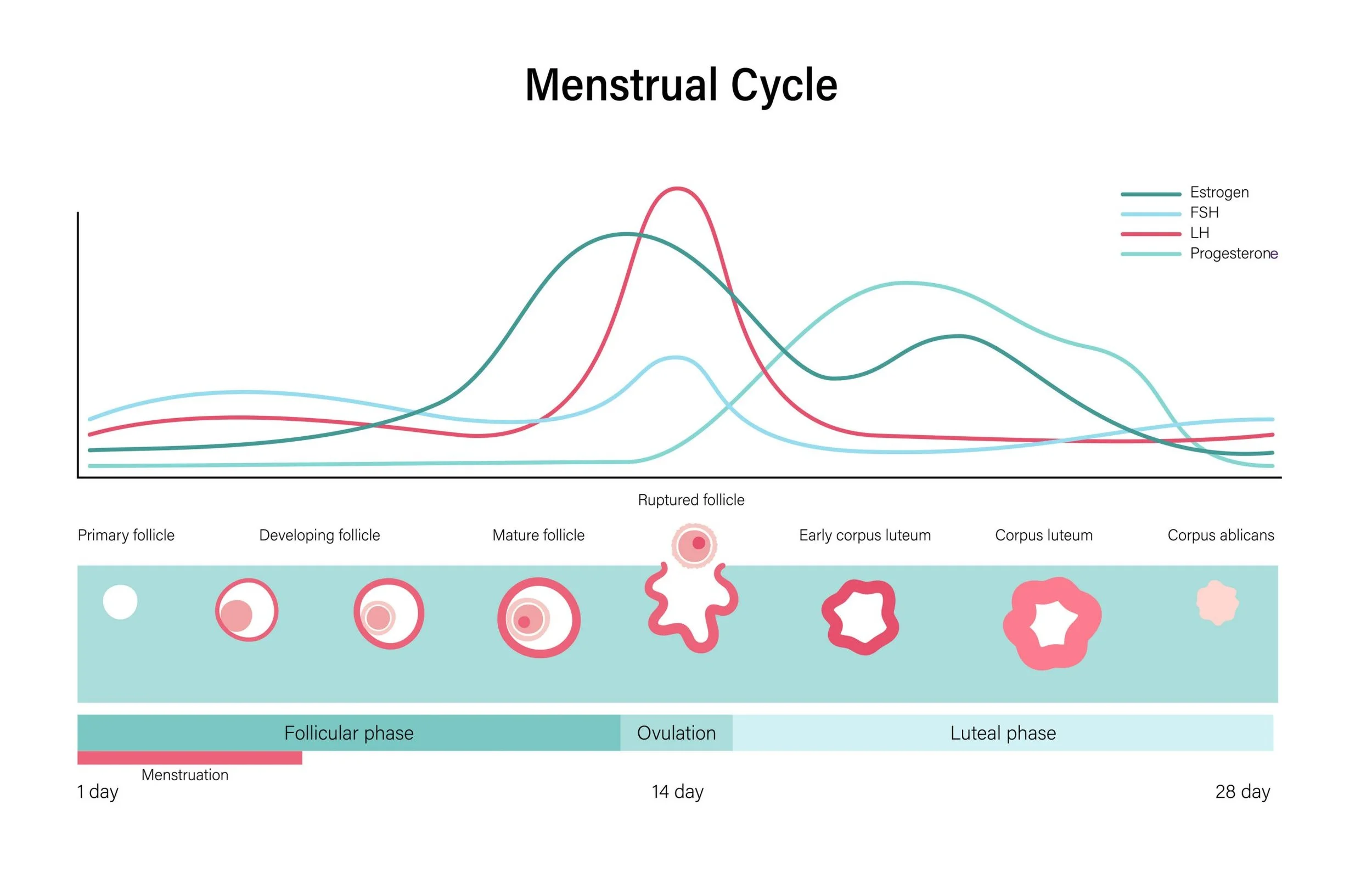
Estrogen and progesterone, even when working completely in sync within their feedback loop with FSH and LH, vary widely within the average 28 day cycle. Anyone remember this picture from health class!?!?!?!
Anytime we check these female hormone levels, it's usually just a spot check. Lab values only tell me, your doctor, what your hormones were doing that moment in time. It doesn’t tell me how your brain receptors are responding to feedback or how efficiently your ovaries are functioning. It doesn't tell me what's normal for you, or if this is different. It won't tell me how this will make you feel.
Only listening to your symptoms and their timeline tells me where your body is in the perimenopausal transition.
Checking labs may start a conversation, but there’s so much more to be said.
My friend’s first sign of perimenopause was ear tingling. I have another friend who developed vertigo. Several people tell me they never had a sign and just stopped having periods one day. Lucky buggers!
Everyone’s experience with perimenopause is different, so how do you know?
Well…my answer isn’t sexy…nor am I selling a quick fix. The truth is, it's often difficult. We have to tease out whether the sleep disruptions are from increased stress, or the night sweats from a broken thermostat. Are we really this angry at our coworker, or is this a mood swing? Many of the symptoms of perimenopause also overlap with other medical conditions, such as thyroid disease, anemia, and autoimmune disorders.
So where to start?
Begin with a timeline. Do the symptoms have a pattern? Are they associated with a certain activity? Has period timing changed? Then take that to a healthcare provider who listens. Labs may need to be checked, or preventative screenings brought up to date to ensure nothing scary is causing these symptoms. Perimenopause may not be the only thing going on. We can still have stress AND thyroid disease AND perimenopause at the same time.
This is why it is so vital that your healthcare provider gets to know YOU.
My goal is to maintain your high-functioning quality of life during the perimenopausal transition. To do this, I need to know YOUR goals. I need to know what symptoms are bothering YOU the most. What is preventing you from living your best life?
—
I like to summarize perimenopause as ‘puberty backwards’. It has all the hormonal ups and downs, all the mood swings, and an unpredictable nature. Many of us enter perimenopause at the same time our pre-teens and teens are going through their changes. Ugh! Help!
You have options!
We used to wait until menopause was complete before we would treat the symptoms, but if you’re experiencing this, you know that the worst is usually in the middle of the transition. More research, advocacy, and education has led more healthcare professionals to treat the symptoms earlier, but medicine is slow to change. It figures. It takes a decade just to educate us!
So how do I know if this is perimenopause?!?!?!
It takes time.
Not every skipped period is the sentinel for ‘the change’, but it could be. Heavy periods could be hormonal changes, or fibroids, or both.
Remember: The #1 symptom of perimenopause is “I just don’t feel like myself”.
You need a provider who listens; Someone who takes the time to tease out what is life threatening vs soul crippling. They ask ‘What makes you, YOU?’. The best providers validate your experience, support your goals, and equip you with the tools you need to navigate this journey.
It’s not just about hormones. It’s about YOU.
Professionally, yes. I chose this on purpose.
I have seen patients in the clinic and via telemedicine. In the noisy clinic, I struggled getting to the root of the problem quickly. I led with open ended questions and listening. I tried learning communication tactics to guide the conversation. I studied how to connect and build trust faster. I worked to make the clinic more inviting. Nothing changed. My patients were angry at me before meeting me, after waiting with screaming children and coughing adults. Doors were slamming, emotions were high, and my patients were guarded.
Over the years, I noticed a phenomenon: Women are more comfortable talking to me when they are in a setting that’s comfortable for them.
When you are at home, or in your office with a closed door, or even parked in your car, you are more at peace than in any doctor’s clinic. It’s easier to talk about what’s really bothering you. Telemedicine is still a face-to-face conversation, in real-time. We are more alone with fewer distractions. You can grab your medicine from your medicine cabinet or look it up on the device you are currently using without it being rude.
And we have more time.
There is no rush. There is no one outside the door waiting for us to come out. There is no other person in the next room also waiting to be seen. There is no traffic to beat to get back to the office.
I have a full hour to focus just on you.
So, can I only see you online? Professionally, yes. Or catch me on the running trails around Allen!
Health insurance dictates so much of the practice of medicine in modern society. What medicine can I take? What pharmacy can I use? Is that specialist in my network? Where and when is my surgery? The care we are allowed to receive is often dictated by a faceless third-party who we’ve never met and may not even be human. At its core, because insurance companies are the main payer, they drive the ‘power of the purse’.
Insurers are at the center of our current healthcare economy.
Health insurance separates people and providers. Because of insurance, I used to spend as much time recording, analyzing, and arguing about the care I was providing as I did actually delivering it.
More intelligent individuals than me are trying to fix this problem. I can’t solve the convoluted economic drivers of healthcare. I can’t control insurance companies. I can exit the system.
Equilibrium Menopause is a direct-pay practice.
Why don’t I take insurance? Because I want YOU to be at the center of your own care.
I had two different people tell me that ‘all the good [healthcare] providers are going that way’. They were both referring to healthcare providers not taking insurance and switching to a direct pay model. Granted, they were both trying to compliment and thank me after spending a full hour completely focused on their health. It just struck me because they both used the same phrasing. This kind of talk used to strike me as sad. I now realize it was because I thought I was being left behind in a broken system.
This time, I was proud of myself.
I love my job again. I can spend the time I need to spend on complicated problems. I am able to ask probing questions and wait for the answer. I can fully explain WHY I don’t need to write a prescription for X diagnosis. I teach how certain exercises help with Y. I sensitively broach the subject of how Z is actually totally normal, just no one talks about it. And here’s a good article to back it up!
When was the last time you (as a healthcare professional or patient) had the luxury of being seen as a fully fleshed complex human being in a medical setting?
Let’s bring human connection back to the center of healthcare.